
5 Commerce Signals Leading CPG Brands Use to Plan Smarter for 2027
At this year’s major industry gatherings, from CAGNY to Shoptalk, CPG leaders shared a consistent message: growth is becoming harder to achieve. Consumer attention is fragmented across more channels, media investments face greater scrutiny, and AI is rapidly reshaping how shoppers discover and buy products.
As these dynamics continue to evolve, marketers are left with critical planning questions:
- Which channels and audiences will drive the strongest returns?
- Which brands, products, and retail partners deserve greater investment?
- Where are the biggest opportunities for growth?
Traditional measurement approaches such as Media Mix Modeling (MMM) and Multi-Touch Attribution (MTA) rely on historical data and lengthy implementation cycles, making it difficult to respond in a timely manner to changing consumer behavior and shifting market conditions.
To address this limitation, brands also need forward-looking commerce signals that reveal emerging demand, measure incremental impact, evaluate retail opportunities, and support more confident investment decisions before budgets are committed.
The challenge is that these signals often exist across disconnected media, commerce, and retail datasets, making them difficult to access and act on at scale. Addressing this requires a more connected measurement approach that links consumer discovery, shopper behavior, media performance, and retail outcomes in a single view.
Drawing on billions of commerce interactions analyzed across the MikMak platform, we've identified five commerce signals that are increasingly shaping how leading brands approach media planning, retail strategy, and growth investment decisions.
1. Portfolio Demand Signals
Organic volume pressure is forcing sharper portfolio discipline across CPG, with brands increasingly concentrating investment behind core products while deprioritizing weaker performers. As a result, marketers are under growing pressure to clearly identify which products deserve continued or increased investment.
Global Shopping Demand Trends Vary by Category and Season
Recent MikMak Shopping Index data shows that purchase behavior varies significantly by category over time, reinforcing the need for more dynamic portfolio allocation:
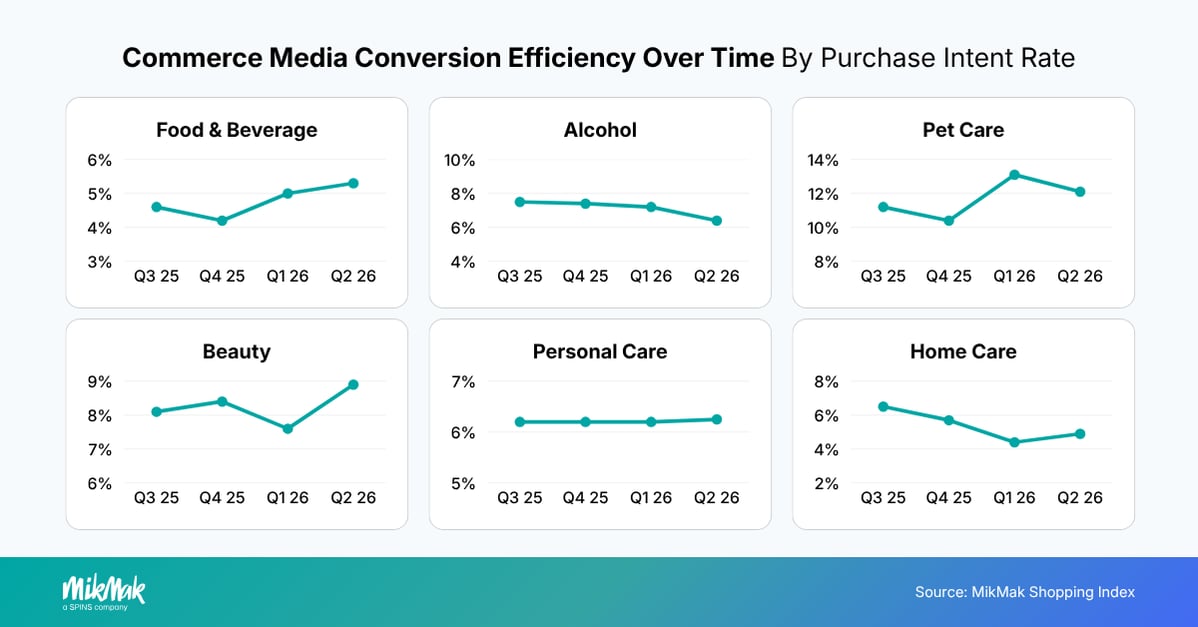
*Purchase Intent Rate: Measures the percentage of shoppers who click through to at least one retailer within MikMak Commerce-enabled brand content, signaling a strong conversion likelihood.
- Food & Beverage: Exhibiting a strong demand rebound, climbing from a 4.2% Purchase Intent Rate in Q4 2025 to 5.3% in Q2 2026.
- Alcohol: Displaying down-market volume compression, flattening from 7.4% in Q4 2025 and sliding to 6.4% in Q2 2026.
- Pet Care: From a slight Q4 decrease to 10.4%, the category surged to 13.1% in Q1 2026 before stabilizing at a highly resilient 12.1% in Q2 2026.
- Beauty: Following a brief dip in Q1 2026 (7.6%), Beauty Purchase Intent Rate has climbed in Q2 to 8.9%, surpassing even Q4 2025 holiday quarter.
- Personal Care: Demonstrating steady utility baseline behavior. Purchase Intent Rate has held firm, maintaining a consistent 6.2% across late 2025 and shifting slightly upward to 6.25% in Q2 2026.
- Home Care: Experiencing tighter consumer spending, softening from a 6.5% Purchase Intent Rate in Q3 2025 down to 4.9% in Q2 2026.
2. Tactic-Driven Conversion
As consumer journeys become increasingly compressed, marketers can no longer assume that awareness and conversion happen in separate stages. Today's shoppers often move from discovery to purchase within a single session, making it critical to evaluate media tactics based on both reach and conversion outcomes.
As Simon Rodeiro of PIM Brands noted during MikMak's recent industry panel:
|
"The funnel’s not really a funnel anymore. Discovery to conversion is happening much faster. It’s a pancake, right? It’s kind of squished. But in that squished pancake, you have to be ready during an awareness campaign to capture that conversion." — Simon Rodeiro, VP of Digital Commerce & Omni-Channel Marketing
|

Full-Funnel Performance Trade-Offs
Global MikMak Shopping Index data highlights how shopper engagement (Commerce Loads) and conversion likelihood (Purchase Intent Rate) vary across campaign objectives:
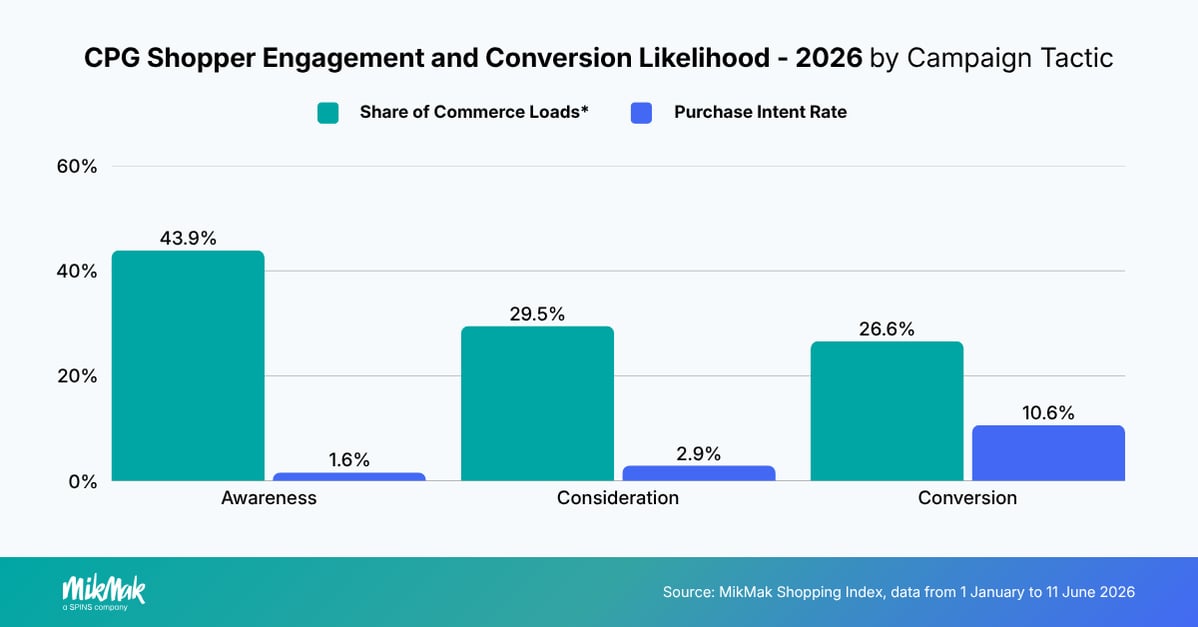
This pattern highlights a clear trade-off between scale and efficiency, with upper-funnel tactics driving the majority of engagement and lower-funnel tactics delivering significantly higher conversion rates.
3. Channel Investment Efficiency
In CPG categories, paid social currently drives more than 63% of shopper traffic to retailers from MikMak Commerce-enabled brand experiences, based on Purchase Intent Clicks, followed by paid video (16.6%) and paid search (7.6%). While traffic volume remains concentrated among a handful of major platforms, volume alone does not determine investment effectiveness.
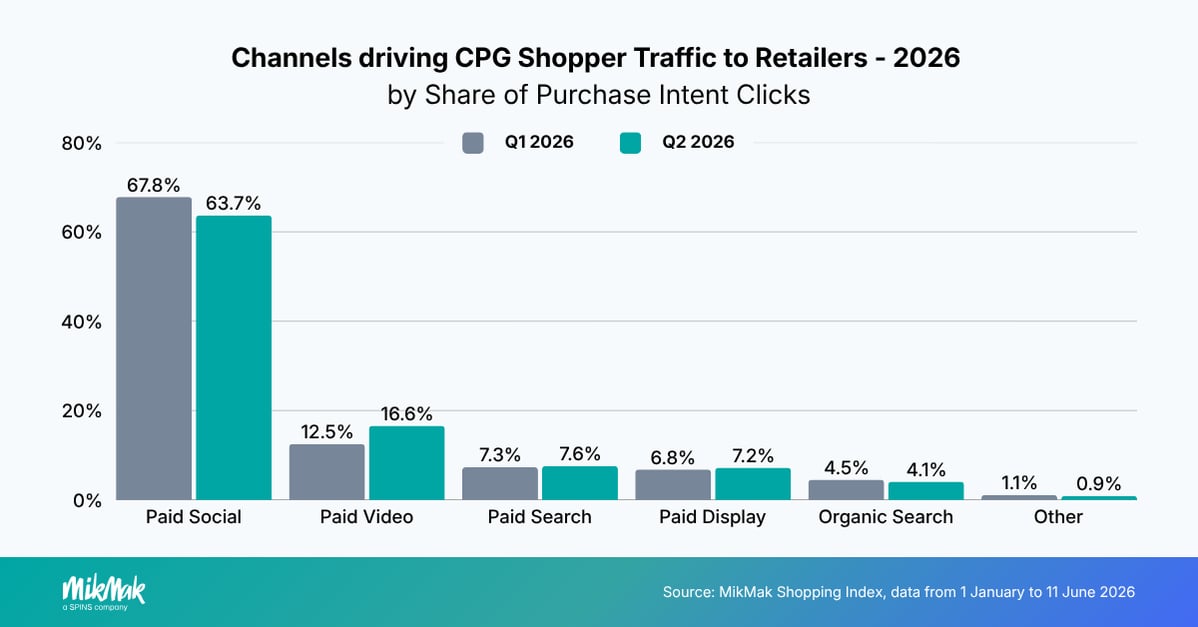
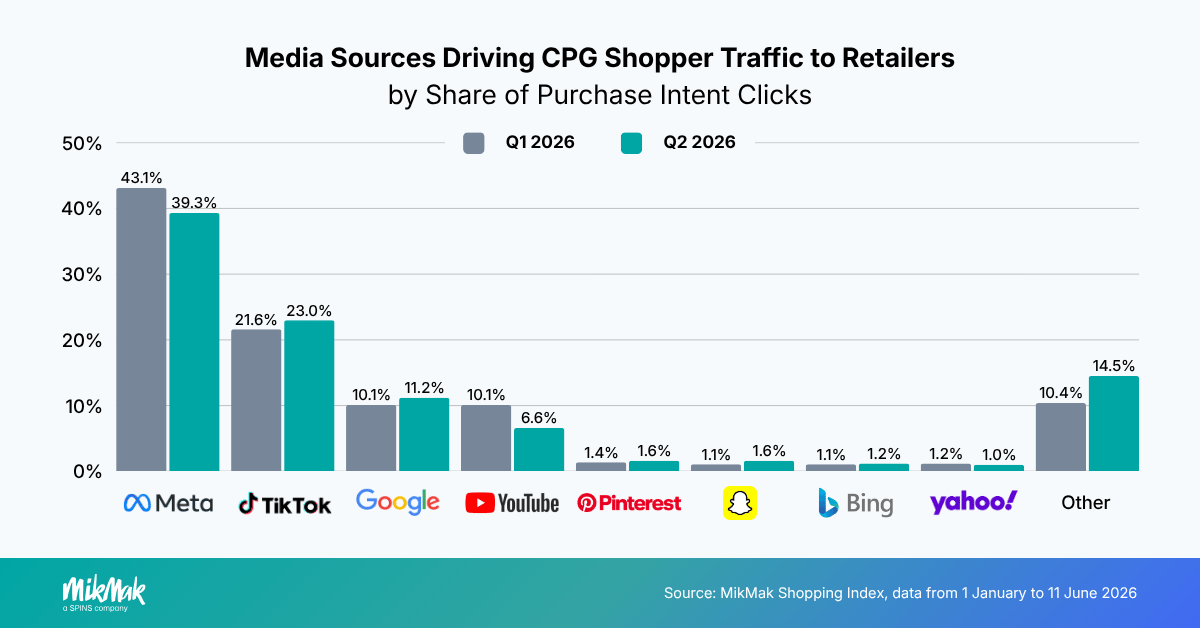
As brands build 2027 media plans, understanding which channels generate the strongest conversion outcomes is becoming just as important as understanding which channels generate the most traffic.
Moving Beyond Last-Click Attribution
As CPG brands build more defensible media plans, relying solely on last-click attribution provides an incomplete picture of performance.
As Amy Elkes of Velcro Companies shared during MikMak's recent panel:
|
“A deeper, richer model, [MikMak] Aura, allows you to go back in time, enter an extended time period of data across lots of vehicles, and really look at how that interaction with the consumer takes place over time. It moves away from just the simplicity of the one-click attribution, which again, is great, but it doesn't tell the whole story.” — Amy Elkes, Director of Global Insights
|

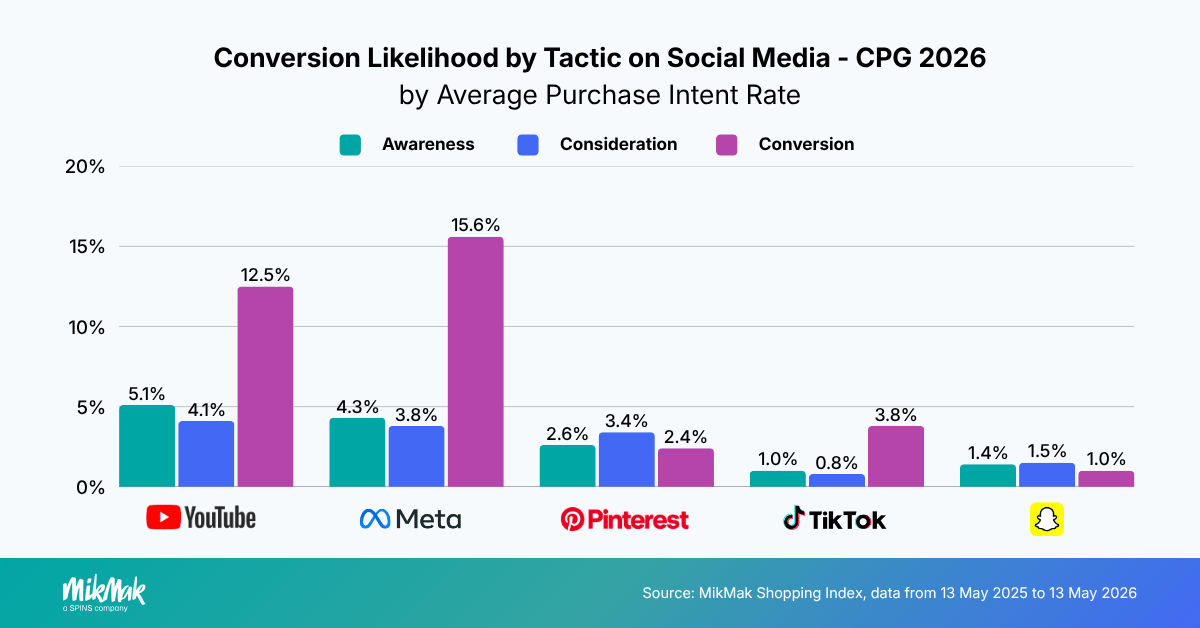
Global MikMak Shopping Index data highlights how conversion effectiveness varies across social platforms depending on campaign objective. While YouTube demonstrates strong upper-funnel performance for CPG brands, Meta currently delivers the highest efficiency for conversion-focused campaigns.
4. AI Discovery Share
Product discovery is shifting toward large language models and conversational interfaces, where consumers increasingly use AI systems to research and choose products. In these environments, only a small number of sources are shown, making visibility more concentrated and competition for inclusion much higher.
This creates a new challenge for brands: without structured product, pricing, and availability data, they risk losing visibility at the exact moment purchase intent is forming.
The Rise of Conversational Referral Channels
MikMak Shopping Index data indicates a significant upward trend in referral traffic from conversational AI environments as consumers increasingly adopt generative tools for product discovery and shopping guidance.
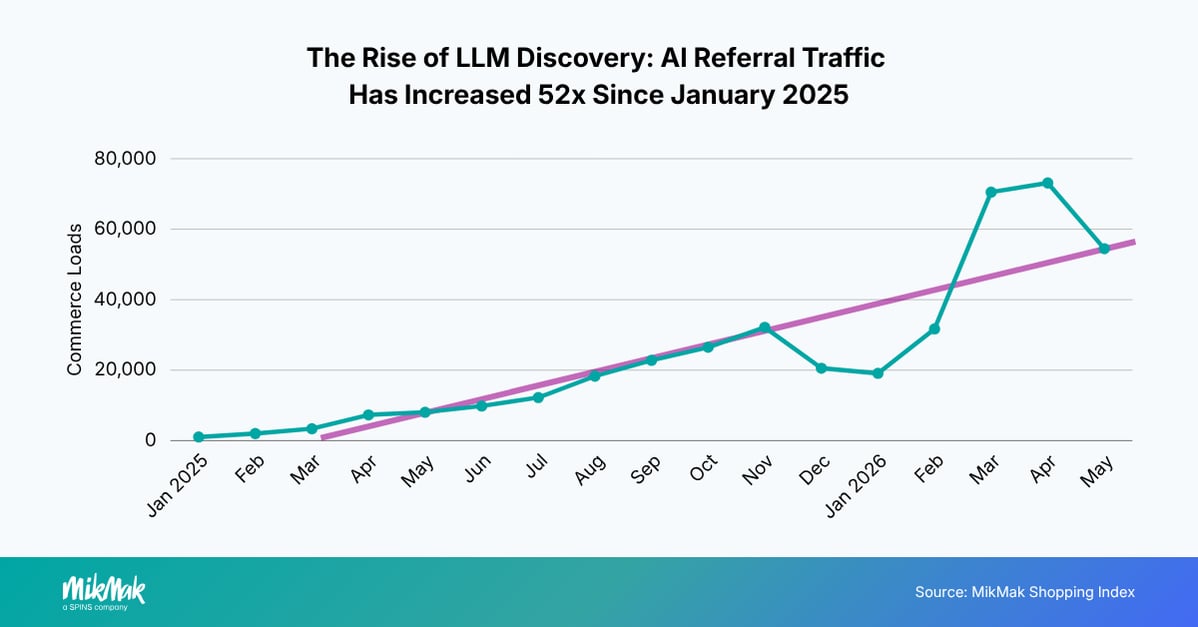
As this channel develops, Generative Engine Optimization (GEO) has become a core requirement for maintaining visibility in commerce ecosystems.
Jack Slattery of Proximo Spirits shared during MikMak’s recent panel:
|
“We need to think more about the 2nd and 3rd levels of discovery... There's a lot of discussion about how to ensure that your brands are showing up in AEO or GEO, on a chat, or on a retailer site. But that conversation hasn't yet revolved around the deeper levels of search results that you might get after that conversation evolves.” — Jack Slattery, Director of Omnichannel & Commerce
|

5. Incremental Revenue Forecasting
As retail media costs fluctuate and macroeconomic conditions shift rapidly, historical reporting alone is no longer sufficient for CPG planning. When leadership demands fast budget decisions in response to market volatility or external pressures, teams cannot rely on fragmented retail reporting or quarterly agency readouts.
To stay retail-ready, media planning must be directly connected to live retailer performance data and predictive modeling across markets, categories, and products.
Proof in Action: Over 3x Incremental Sales Growth
MikMak Aura enables real-time forecasting for enterprise and challenger brands navigating volatile market conditions.
As Rachel Tipograph, Founder and CEO of MikMak, shared during a recent industry panel:
|
"Velcro participated in our beta... we really focused on how we can help them optimize their sales at places like Amazon and Walmart. And with MikMak Aura, they were able to identify how to drive over 3x the amount of incremental sales by moving dollars into environments like Walmart DSP, Influencers, TikTok, and Pinterest." — Rachel Tipograph, Founder & CEO
|

During the same panel, Amy Elkes of Velcro Companies added:
|
“The [MikMak Aura] model affirmed a lot of what we're doing, but it also said, maybe you're hitting a point of diminishing returns on some of these vehicles, and you might really want to think about putting those dollars into what are smaller bets for you now, because there's a lot of room for growth.” — Amy Elkes, Director of Global Insights
|
Conclusion: Building an Agile, Data-Driven Playbook for 2027
As CPG brands plan for 2027, the gap between traditional measurement approaches and modern commerce execution continues to widen. Volume pressure, compressed funnels, and AI-driven discovery are reshaping how consumers shop and how marketing performance must be evaluated.
In this environment, backward-looking reporting is no longer enough. Leading brands are shifting toward continuous optimization powered by real-time commerce intelligence.
The five commerce signals outlined in this playbook, from demand trends to incremental revenue forecasting, provide a framework for making faster and more confident investment decisions across channels, tactics, and retail partners.
By operationalizing these signals, marketing teams can better allocate budget, reduce inefficiency, and align media investments directly with commercial outcomes.
