
Shoppers no longer follow straight paths to purchase. They might discover a product on social media, find it through paid search, validate it on a brand’s or retailer’s website, but buy wherever it is easiest in the moment.
If convenient checkout options based on shoppers’ retailer preferences are missing, brands lose sales opportunities. When purchase intent is captured in just one place or measurement is inconsistent, brands lose visibility, efficiency, and incremental growth.
This blog outlines why enabling multi-retailer commerce across both media and brand websites drives measurable results. Using industry benchmarks, MikMak data, and real-world case studies, we show how a unified, multi-touchpoint commerce strategy helps brands capture more demand, reduce friction, and make smarter marketing decisions.
Why Commerce Everywhere Matters
Brand Websites Convert Smaller but High-Intent Shopper Audiences
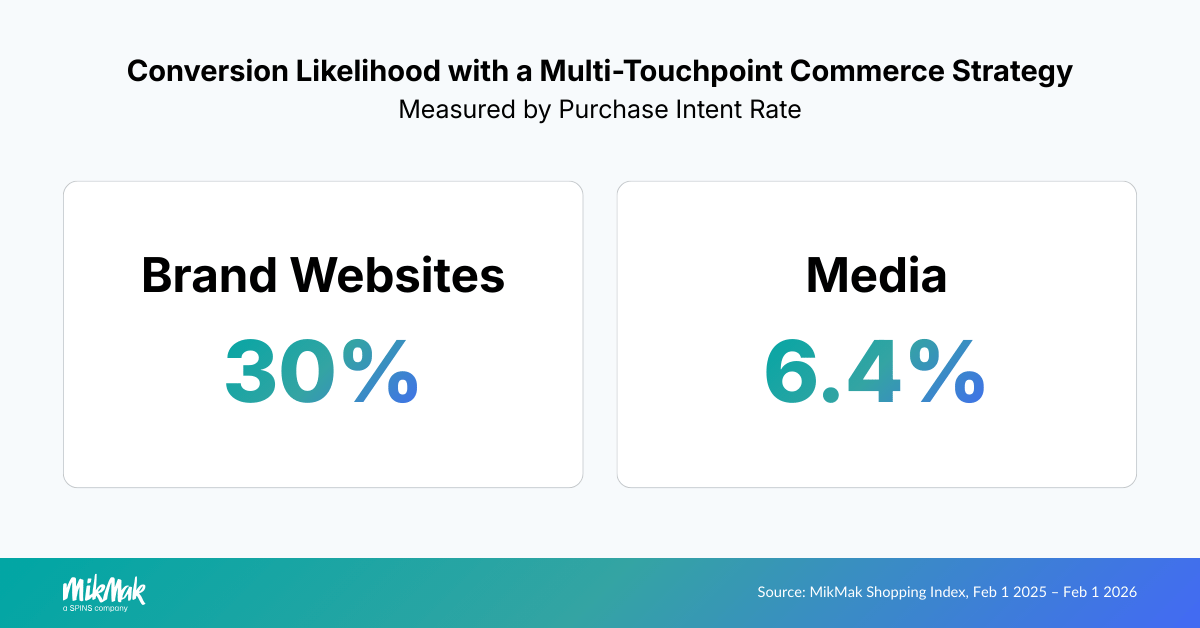
Multi-retailer commerce on brand websites captures purchase intent from highly qualified visitors. Brand sites are critical at the bottom of the funnel, helping shoppers validate products, explore options, and choose where to buy. These audiences are smaller than those reached via media, but highly motivated to convert.
MikMak data highlights:
-
Brand websites deliver a high conversion likelihood across categories like Beauty, Personal Care, Alcohol, Food, and Beverages
-
Commerce-enabled media reaches shoppers earlier, driving shopper traffic and creating incremental opportunities before visitors reach the brand site
Product Discovery Happens in Media
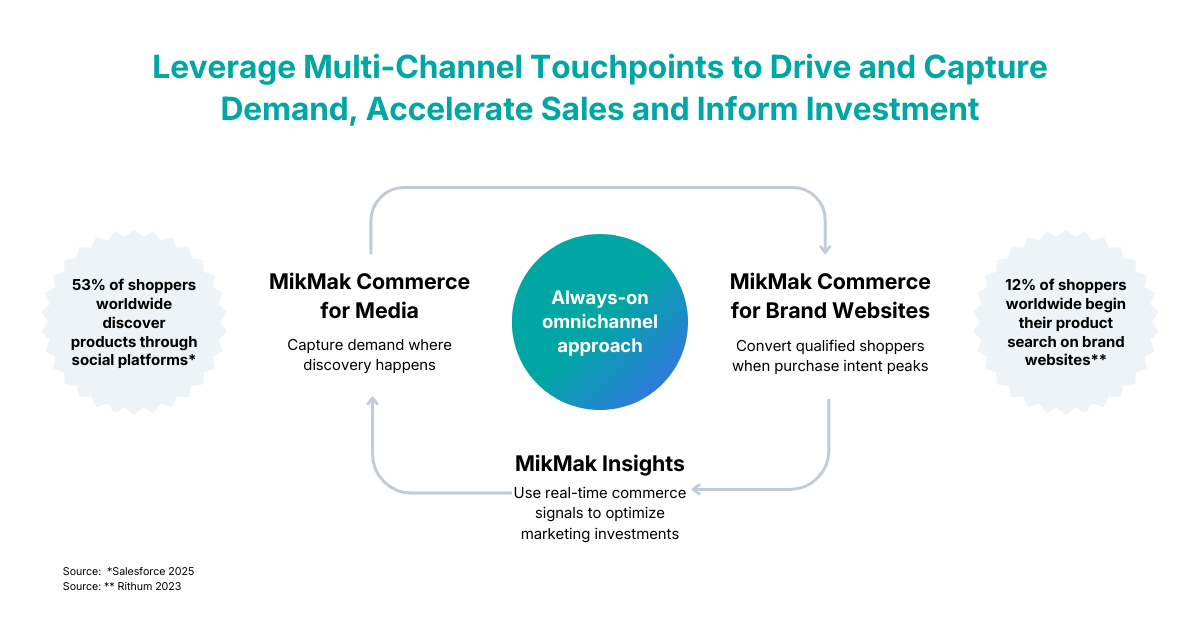
While brand websites convert well, discovery rarely starts there. More than 50% of shoppers worldwide discover products on social platforms, while only 12% begin their product search on brand websites.
After product discovery, many shoppers search marketplaces (38%), visit a preferred retailer’s website (18%), or check local store availability (18%). As a result, a large share of shoppers may never even reach the brand website.
If media campaigns don't make it easy for shoppers to buy a product from their preferred retailer, brands miss the opportunity to capture purchase intent when it first appears.
Media Is a Major Driver of Shopper Traffic to Retailers
Media can do far more than build awareness. Across brands using MikMak, media channels drive the majority of shopper traffic to retailers, measured by Purchase Intent Clicks.
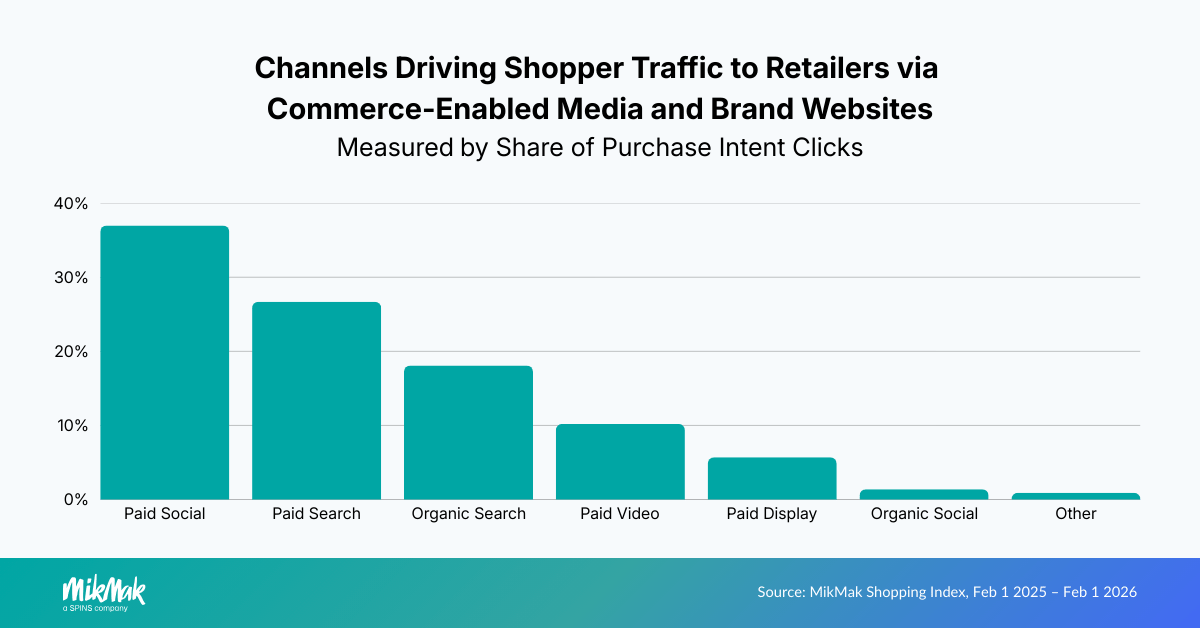
Media is one of the primary ways shoppers move from discovery to purchase. Global consumer research supports this behavior: 63% of 18- to 25-year-olds say social media influences their purchase decisions, and 42% of consumers have clicked an online ad with intent to buy.
Commerce Everywhere Connects the Funnel
When commerce is enabled only on media, brands risk losing continuity as shoppers move downstream. When it’s enabled only on brand websites, early purchase intent remains invisible. Many industry-leading brands solve this by activating commerce across both paid and owned channels and measuring it through a single framework.
With MikMak, brands connect these touchpoints through an always-on omnichannel approach. They’re capturing demand wherever it appears and optimizing their strategy at every stage of the funnel to increase conversions.
Five Reasons to Adopt a Multi-Touchpoint, Multi-Retailer Commerce Strategy
If you’re still weighing the opportunity, here are five reasons why many leading brands are enabling multi-retailer commerce across both media and brand websites. Each is supported by real-world examples showing how this approach drives stronger performance.
#1: Capture First-Party Data Across the Full Shopper Journey
First-party data is now the most valuable asset in digital marketing. And it’s only as strong as the touchpoints it covers.
When commerce is enabled in just one place, brands collect partial signals. Brand websites capture late-stage purchase intent from a smaller, highly qualified audience. Media captures earlier demand at scale, but those signals may be fragmented or trapped in channel silos.
Enabling multi-retailer commerce across both media and brand websites allows brands to capture consistent, high-quality purchase intent signals across the full funnel, including:
-
Product-level engagement
-
Retailer preference
-
Buy-now and add-to-cart actions
With a unified commerce solution like MikMak, these signals are captured in one system rather than across disconnected platforms. This gives brands clearer visibility into what is driving retailer outcomes and enables stronger retargeting, more accurate lookalike audiences, and smarter optimization, without relying on third-party data.
💡 Key takeaway: Full-funnel first-party commerce data creates a more complete view of demand and supports better decisions in a privacy-first world.
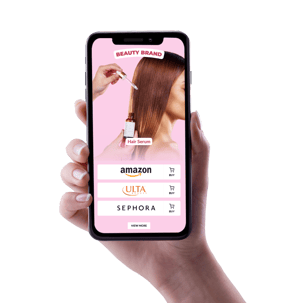
🪮 Case study: U.S. Hair Care Brand
After enabling multi-retailer commerce with MikMak across both brand websites and paid media, the hair care brand increased attributable sales and improved media efficiency.
|
Results:
|
 |
#2: Drive Incremental Demand Instead of Optimizing in Silos
Single-touchpoint commerce marketing strategies can deliver strong results in isolation, but they risk leaving demand on the table.
-
Brand websites convert highly qualified visitors, but miss early-stage shoppers who discover products elsewhere but never visit the site
-
Media generates discovery-stage demand but may lose continuity as shoppers move downstream or seek more information on brand websites
Enabling multi-retailer commerce across both media and brand websites allows brands to:
-
Capture purchase intent that would otherwise go unseen
-
Convert shoppers on both media and brand websites
-
Maintain measurement continuity across the full shopper journey
💡Key takeaway: Multi-touchpoint commerce enablement creates measurable incremental growth across the funnel.
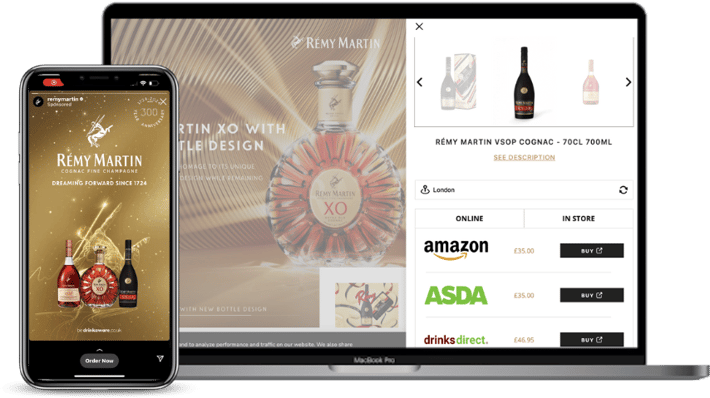
🍸 Case study: Remy Martin UK
Remy Martin UK had already integrated MikMak Commerce on its brand website. The team then ran a pilot activating shoppable campaigns across paid media, offering consumers multi-retailer checkout options.
#3: Reduce Friction by Shortening the Path to Purchase
Every extra step between product discovery and checkout increases drop-off. When commerce is not enabled across channels at the moment of purchase intent, shoppers either have to switch channels or search again, increasing the risk of losing sales opportunities.
Enabling commerce across media and brand websites ensures:
-
Immediate paths to purchase at the moment of purchase intent
-
Support for shopper preferences, including online vs. offline buying options
-
Reduced drop-offs and lost demand
💡Key takeaway: Wherever shoppers show purchase intent, a clear and convenient path to purchase should already exist.
📺 Case study: Hisense Australia
Hisense Australia initially used MikMak Commerce solely on their brand website. They expanded to paid media campaigns with multi-retailer checkout options to maximize marketing investments.
|
Results:
|
 |
#4: Build Stronger Audiences to Improve Marketing Efficiency
Marketing performance doesn’t improve by simply spending more; it improves by targeting smarter. When commerce is enabled across both media and brand websites, brands can capture real purchase intent signals and build high-quality audiences across the funnel, from discovery through conversion.
Real commerce signals allow brands to:
-
Identify high‑value shoppers earlier in the journey
-
Build more precise lookalike audiences based on actual purchase behavior
-
Retarget with stronger signals, leading to better engagement and lower wasted spend
-
Allocate budgets more efficiently toward audiences most likely to convert
These audiences improve efficiency and scale because they reflect true shopping behavior. That means budgets go further, CPMs improve, ROAS increases, and campaigns become more predictable.
💡Key takeaway: Commerce audiences drive smarter spend. Brands don’t just reach more people, they reach the right people, with budgets that deliver measurable gains in efficiency.
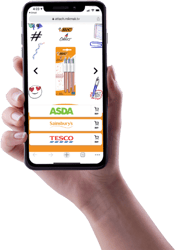
🖊️ Case study: BIC UK
BIC UK used to rely on generic first-party audiences, leading to higher CPMs and lower engagement. With MikMak and their agency, BIC started to track audiences signaling purchase intent and built stronger lookalike audiences based on real commerce behaviors.
|
Results:
|
 |
#5: Measure What Matters with One Consistent Framework
When commerce is enabled on a single touchpoint or measured in silos with inconsistent metrics, performance comparisons become subjective and inaccurate. This makes it very hard for brands to make efficient optimizations.
A unified commerce solution across media and brand websites brings all commerce signals into one consistent framework. Instead of stitching together fragmented reports, teams get real-time visibility into the full shopper journey, from first touch to final retailer sale, in a single place. This unified view eliminates blind spots and supports smarter, faster decisions about where and how to invest marketing dollars.
Why it matters for performance:
- Aligns measurement across paid media, brand sites, retail media, and other channels
- Enables apples-to-apples comparisons of KPIs like conversion, cost per acquisition, and retailer performance
- Replaces fragmented reporting with real-time insights that teams can act on immediately
This approach mirrors the shift many leading brands are making away from disconnected point solutions toward a centralized commerce layer that standardizes shoppability, data collection, and attribution across every channel. That consolidated view not only reveals which channels and creatives drive real business outcomes, but also helps brands optimize spend with confidence rather than guesswork.
💡Key takeaway: Unified measurement enables brands to manage budgets and optimize marketing performance with more confidence and clarity.
🥫 Case study: Kraft Heinz
Consolidating solutions with MikMak allowed Kraft Heinz to connect data, improve the consumer experience, and uncover new growth opportunities.
As we started to engage with MikMak, one of the benefits wasn’t just the solution, but being able to connect the data and say: Okay, if I’m improving the consumer experience and I’m improving our ability to convert and send qualified traffic to our retailers, I’m starting to create a new value opportunity for our business, that sales team will want to hear, our retail partners will want to hear, and ultimately our brand teams will want to hear.”
Global Head of Digital Experience & Growth, Kraft Heinz
Conclusion: Commerce Works Best When It’s Unified and Everywhere
Shoppers don’t think in channels, and neither should your commerce strategy. Discovery happens in media, validation happens on brand or retailer websites, and conversion happens wherever it’s easiest for the consumer.
Brands that enable multi-retailer commerce across both media and brand websites, and a unified measurement strategy, gain:
- A single source of truth for performance comparison
- Reduced friction and incremental sales
- Stronger audiences built from real purchase intent signals
- Full-funnel visibility from discovery to conversion
- Smarter, more profitable growth with cost-effective investments
The brands winning in commerce enable purchase everywhere it matters, capturing intent at every stage and making it easy for consumers to act when they’re ready.
If you’d like to see how MikMak helps leading brands unlock multi-touchpoint commerce growth, request a demo today.
