
Anyone leading commerce strategy at a consumer-facing brand already knows that the industry is in a state of flux. They can see the volatility in their quarterly reports and the shifting dynamics of retail media.
What is less evident is where to find the next "pocket of demand." During MikMak’s recent Commerce Growth Summit, MikMak Founder and CEO Rachel Tipograph noted that the industry is currently at a "precipice moment." As consumer attention fragments and data privacy continues to evolve, the strategies that built the billion-dollar brands of the last decade will not be the ones they need to continue growing into the future.
The patterns emerging in early 2026 provide a clear playbook for how brands must evolve their planning, activation, and optimization to capture incremental growth. Based on discussions with brand leaders during the summit, four shifts are emerging that will shape commerce media strategy this year.
1. Volume is the New North Star
The most significant trend dominating 2026 is a disconnect between revenue and volume sales. While many CPG brands are seeing revenue growth driven by price hikes or M&A, actual volume sales continue to face downward pressure.
What This Trend Reveals
As volume growth becomes harder to sustain, brands can no longer rely on broad media investment alone to maintain demand. Revenue growth may still be driven by pricing changes or portfolio expansion, but those signals can mask underlying declines in product movement.
This shift is forcing commerce teams to evaluate media not just by reach or engagement, but by its ability to drive measurable retail outcomes. Instead of distributing budgets evenly across campaigns and SKUs, many brands are concentrating investment on a smaller set of “hero” products and retail partners where demand is actively converting into volume.
2. Real-Time Allocation Is Replacing Retrospective Analysis
One issue surfaced repeatedly: brands are making retailer-level investment decisions with incomplete or delayed data.
Disconnected retail reporting and legacy media mix models (MMMs) often produce conflicting signals. By the time data is consolidated and relevant insights analyzed, the moment to act has already passed.
As Annie Plunkett, Traffic & Media Manager at Made by Gather, noted, without a unified view, it is "difficult to have a strong apples-to-apples comparison between our retailers if we ever need to decide where to heavy up on media spend."
Source: Annie Plunkett, Made By Gather, MikMak Commerce Growth Summit [Watch the full webinar]
What This Shift Reveals
The limitation isn’t visibility, it’s timing. Traditional media mix models (MMMs) were designed for quarterly or annual analysis, but today’s retail dynamics shift week to week, if not faster. By the time insights are consolidated, the opportunity to adjust spend has often already passed.
What brands increasingly need is an always-on decision layer that connects commerce media inputs directly to retailer performance and enables teams to reallocate investment while campaigns are still in flight.
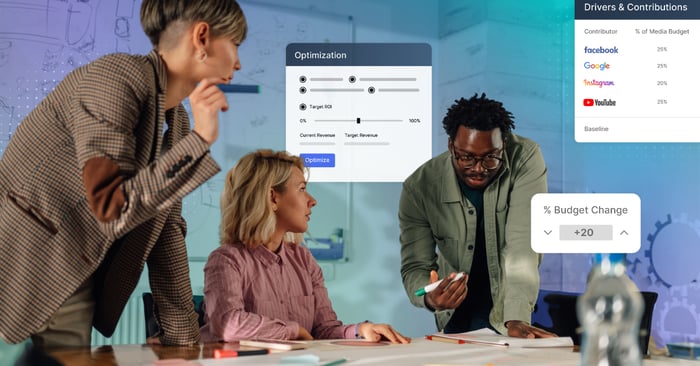
MikMak Aura was built to support exactly this shift, helping commerce teams model potential reallocations across channels and understand how those changes may impact retailer performance before moving budget.
In beta testing, this approach has already produced measurable results. For example, Made by Gather identified that TV investment was driving stronger returns on Amazon while underperforming at Best Buy. By reallocating spend in real time, the team unlocked nearly $1M in incremental sales.
3. Reducing the Gap Between Inspiration and Purchase
As consumer behavior fragments across Social, Search, and Retail Media, the window between awareness and purchase continues to compress. Discovery no longer unfolds in a linear path. It happens in moments, and those moments are increasingly transactional.
If a consumer sees a product on social media but encounters an out-of-stock notification, pricing inconsistency, or a broken link after trying to purchase, the demand does not wait. It disappears.
As Ben Galvin, Senior Director of Omnichannel Retail Sales & eCommerce at Monster Energy, shared during the Commerce Growth Summit, “Friction equals delay. If people and consumers can't go from ‘I want it now’ to ‘it’s in my hand’ instantly, they drop.”
Source: Ben Galvin, Monster Energy, MikMak Commerce Growth Summit [Watch the full webinar]
What This Change Reveals
The competitive battleground is no longer just media efficiency. It is operational precision.
Moment-based shopping requires more than strong creative or channel mix. It requires real-time visibility into product availability, retailer performance, and commerce signals that determine whether demand can actually convert.
In the current environment, the brands pulling ahead are those reducing the distance between signal and action, turning eCommerce insights into operational precision and ensuring that media exposure aligns with inventory readiness and retailer strength.
MikMak’s integration with SPINS supports this shift by incorporating granular, point-of-sale and product availability data into commerce decision-making. The introduction of the Model Context Protocol (MCP) further enables these structured commerce signals to feed directly into internal AI models, allowing teams to operationalize insight rather than simply analyze it.
4. Traffic Visibility Alone Is No Longer Enough
Traffic is one of the clearest early indicators in modern commerce, but traffic without alignment to retailer readiness is noise.
The brands pulling ahead are not simply measuring performance. They are orchestrating it, connecting planning, buying, inventory visibility, and measurement in a single decision loop.
In an environment defined by volatility and compressed demand cycles, the advantage belongs to teams who can identify acceleration early and adjust retailer strategy before volume is lost.
What This Shift Reveals
Traffic signals alone are no longer enough to drive growth. Brands need the ability to translate those signals into coordinated action across media investment, retailer strategy, and product availability.
MikMak 4.0 was built to support that shift. By unifying commerce signals and media inputs, teams gain clearer visibility into how performance translates into measurable retail impact, and where intervention is required.
What Brands Should Do Next
Major retail shifts don’t reward scale alone. They reward preparedness and speed. As you plan your H2 strategy, pressure-test your approach against this checklist:
✔ Audit for Friction: Identify where demand is leaking, from inventory gaps to inconsistent digital shelf execution
✔ Prioritize Allocation Speed: Replace delayed reporting cycles with intelligence that enables in-flight retailer and channel reallocation
✔ Protect Incrementality: Ensure “hero” investments are generating new volume, not redistributing existing demand
✔ Operationalize Your AI: Turn eCommerce insights into AI-powered decisions using structured, first-party commerce signals instead of disconnected third-party inputs
If you're looking for greater confidence in how your media investments drive incremental growth:
👉 Schedule a demo to explore MikMak Aura
Want to hear directly from the brand leaders shaping this shift?
👉 Watch the full Commerce Growth Summit on demand
