
Commerce leaders don’t need convincing that major retail moments matter.
They already see the surge in media investment, creative activation, and retailer coordination around events like the Super Bowl. What’s harder to see, and harder to manage, is how shopper traffic actually behaves when cultural attention accelerates demand.
Using MikMak’s Purchase Intent Clicks and eCommerce analytics, we analyzed Food & Beverage shopper traffic among brands running shoppable media campaigns linked to the Super Bowl from early January through game week 2026.
These patterns provide a clear playbook for how brands should plan, activate, and optimize around upcoming high-impact retail moments.
Shopper Traffic Builds in Waves, Not a Single Spike
Events like the Super Bowl function as tentpole moments, predictable periods of concentrated attention that anchor brand investment across the year. But the data shows that shopper traffic does not rise once. It rises in phases.
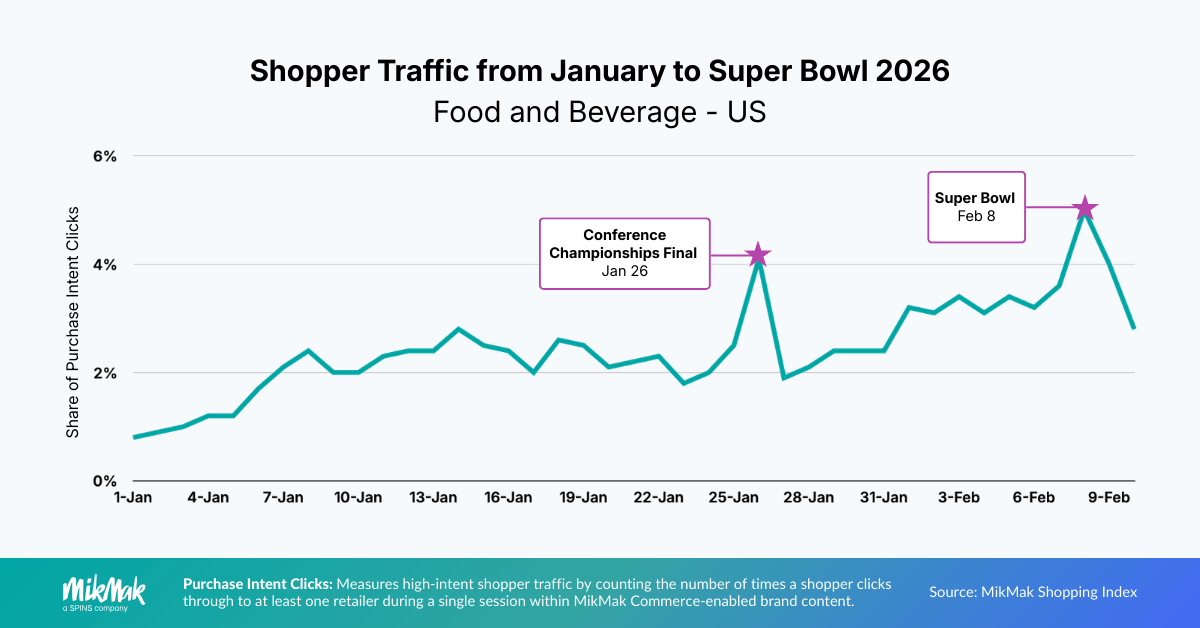
Shopper traffic peaked on:
-
January 26 (Conference Championships)
-
February 8 (Super Bowl)
The Conference Championship spike was nearly as strong as the game itself.
What This Reveals
Consumer stock-up behavior is tied to the event calendar.
The Conference Championships represent an early bulk-buying wave. The Super Bowl drives the final surge, replenishment, and urgency-driven purchases.
Brands that concentrate spend exclusively on the final event day risk missing the first meaningful wave of traffic. Major retail moments behave more like compressed commerce cycles than one-day spikes.
Super Bowl Advertising Drove a 60.7% Lift in Shopping Intent
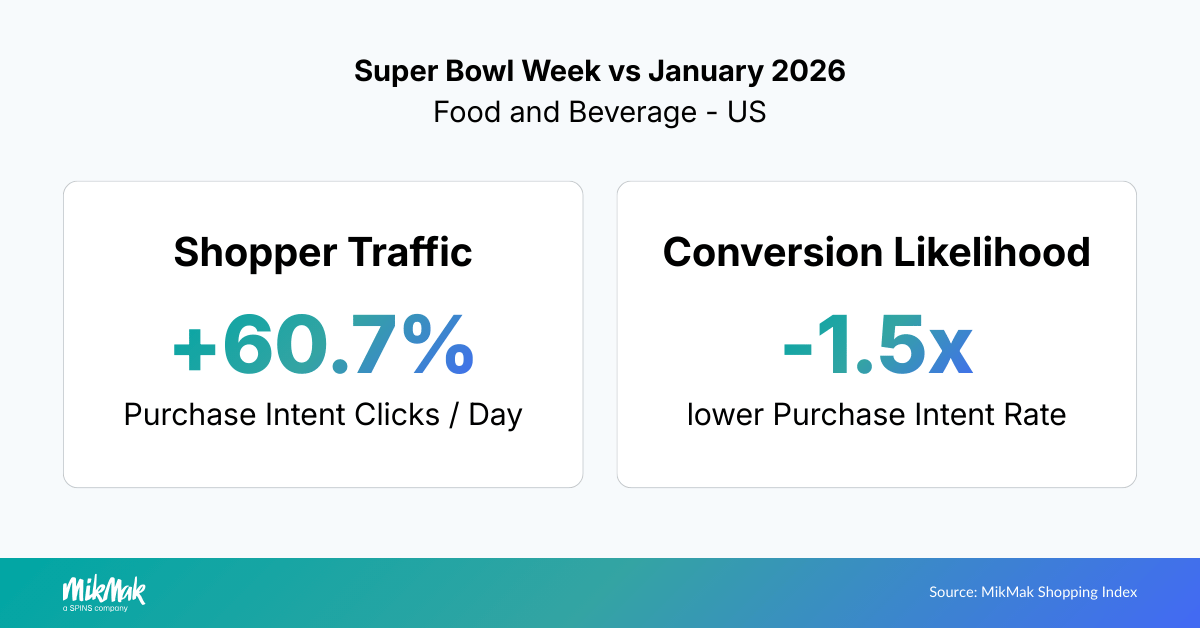
For brands activating shoppable media during Super Bowl week, daily Purchase Intent Clicks, which measure shopper traffic to retailer partners, rose 60.7% compared to January baselines.
This represents a significant increase in measurable retail action, not just engagement.
What This Reveals
The Super Bowl doesn’t just build awareness. It generates a concentrated wave of “hand-raisers” actively moving toward purchase.
During high-impact retail moments, the path from exposure to retailer action compresses dramatically. Consumers respond quickly when attention and urgency align.
But acceleration amplifies friction. If retailer links break, inventory misaligns, or creative lacks clarity around where to buy, the opportunity disappears just as quickly as it forms.
Acceleration rewards operational readiness.
Volume Increased, But Efficiency Tightened
While total Purchase Intent Clicks rose sharply, overall Purchase Intent Rates declined compared to January averages, signaling higher traffic, but tighter efficiency.
What This Reveals
High competition and creative saturation make it harder — and more expensive — to convert a single shopper during the Super Bowl window.
When every brand activates simultaneously, media costs rise and shoppers evaluate more options before committing.
Traffic growth alone does not guarantee incremental growth. Real-time eCommerce analytics make this tension visible, showing when rising volume masks declining efficiency.
Maintaining January-level efficiency during high-impact periods requires distinctive creative and real-time performance optimization across channels and retailers.
Search Lost Share. Shoppable Media Gained Ground.
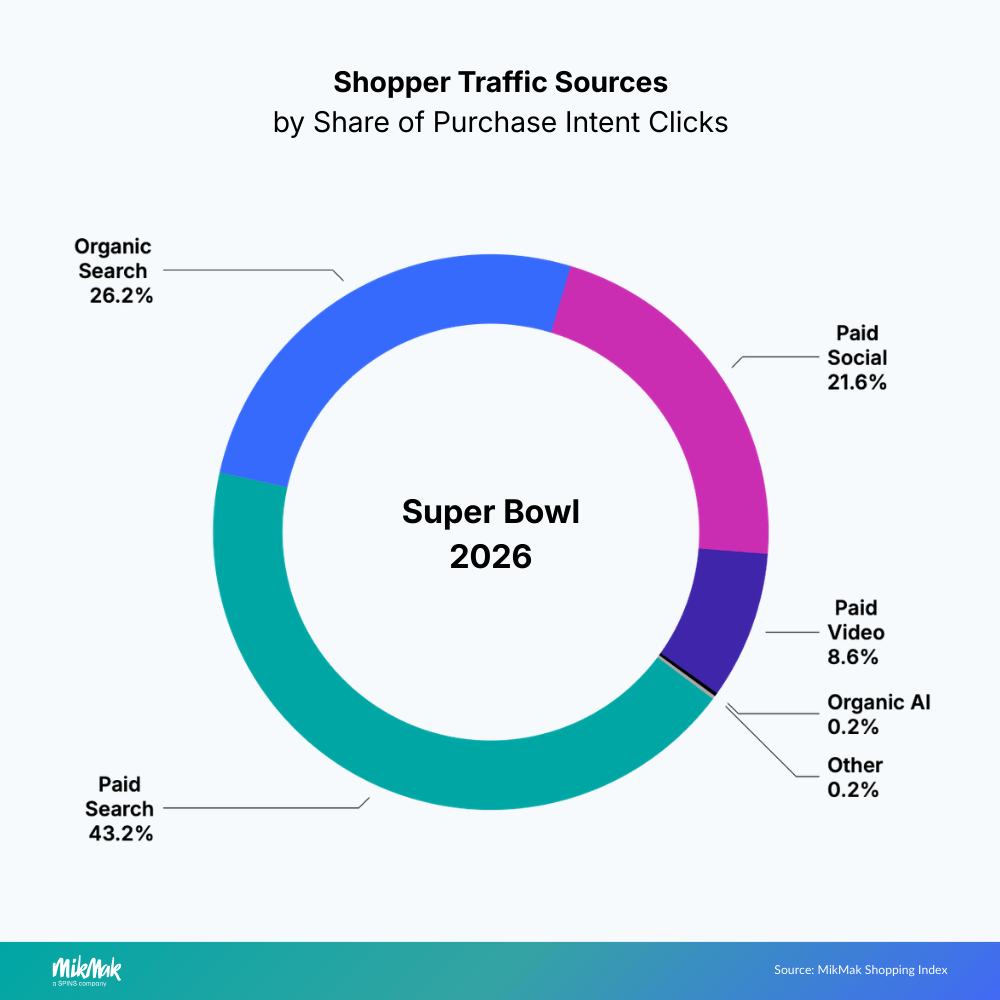
Channel mix shifted meaningfully during the Super Bowl window:
- Paid Search traffic share declined from 53% to 43%
- Paid Video increased from 3% to 8%
What This Reveals
Consumers moved away from searching for solutions and toward purchasing from inspiration.
The rise in video-driven shopper traffic shows that high-impact shoppable media captured impulse behavior before consumers initiated search.
For commerce leaders analyzing performance through eCommerce analytics, this reinforces an important shift: upper- and mid-funnel exposure can behave transactionally during major retail moments.
Search remains foundational, but it does not exclusively own peak demand.
Platform Dynamics Shifted Under Pressure
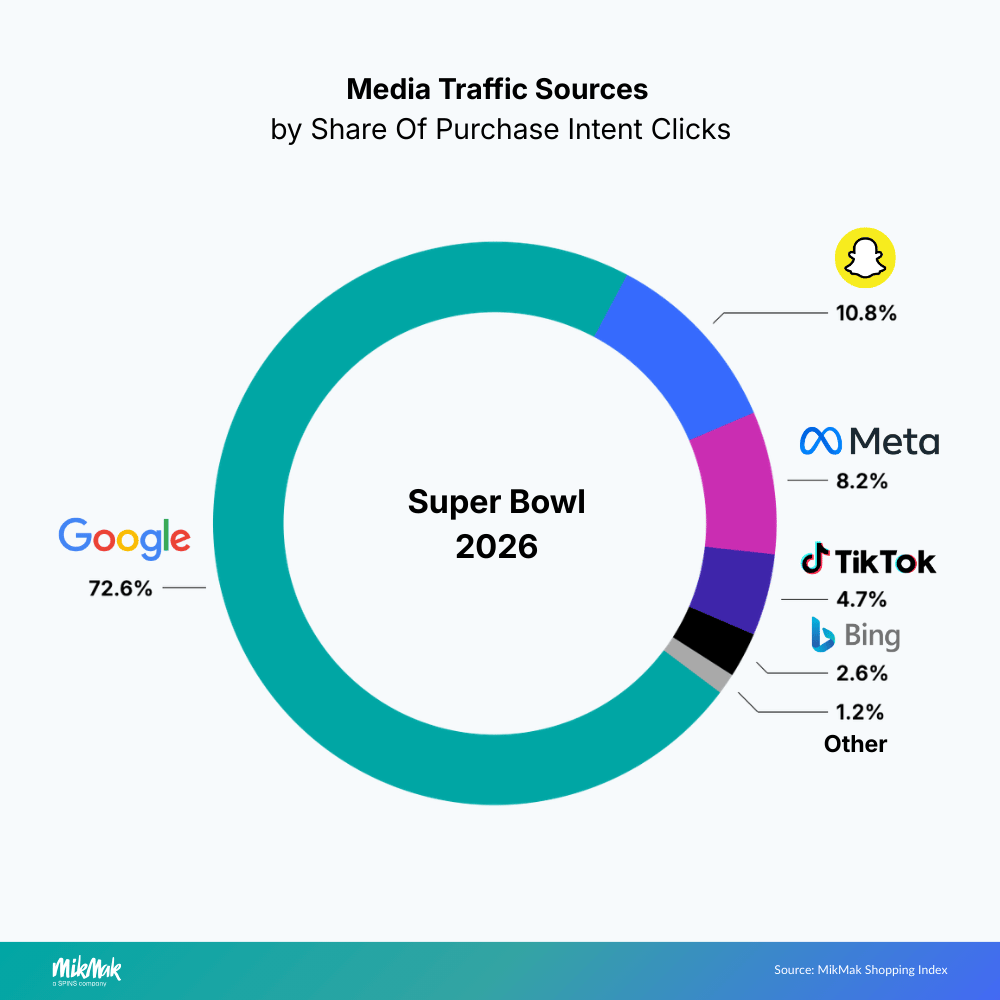
Snapchat climbed to the #2 shopper traffic source during the Super Bowl window, capturing an 11% share, while TikTok dropped to #4.
What This Reveals
Occasion-based buying can reshuffle platform performance.
Snapchat’s strength during this period suggests its audience engaged more actively with hosting-driven, “buy now” calls-to-action. During urgency-driven retail cycles, evergreen platform benchmarks may not hold.
Without visibility into traffic movement by platform, brands risk optimizing toward outdated assumptions.
Retailer Distribution Reflects Shopper Behavior
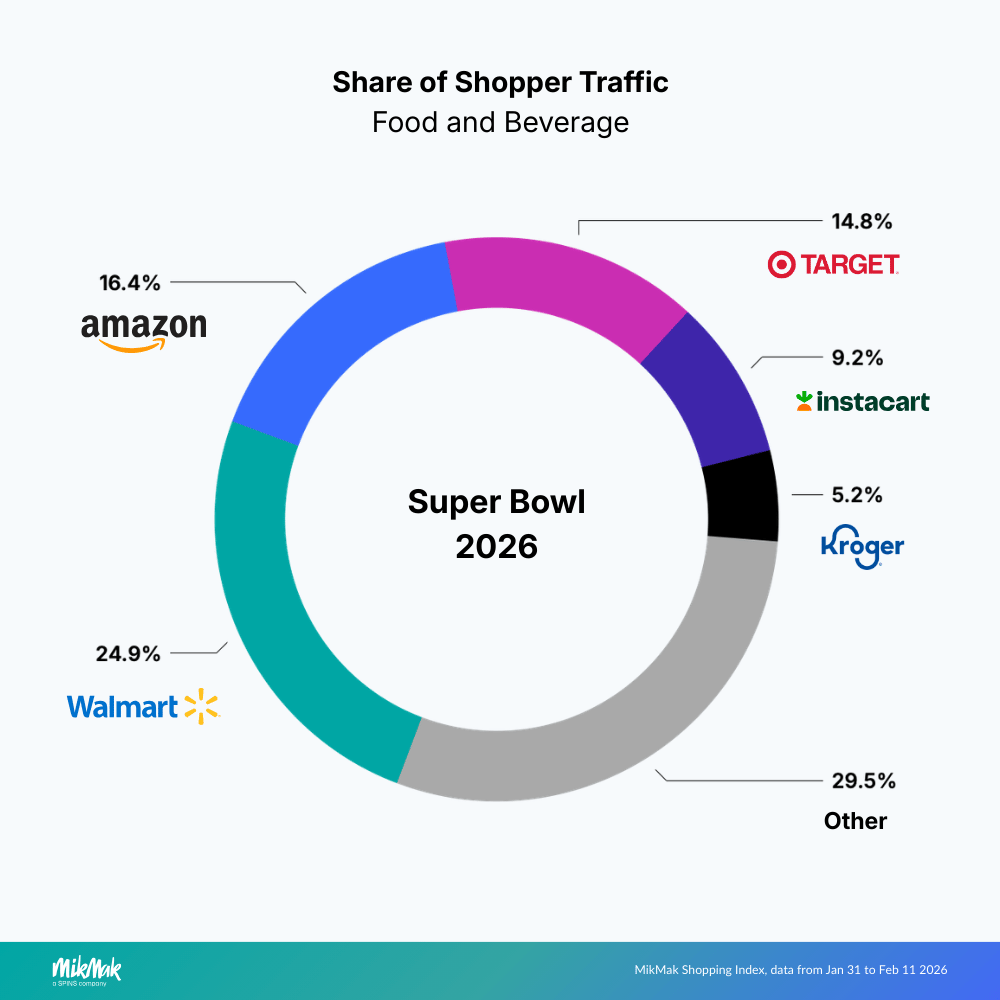
Traffic did not concentrate evenly across retailers during the Super Bowl window. It clustered around specific retail behaviors.
- Walmart: 24.9%
- Amazon: 16.4%
- Target: 14.8%
- Instacart: 9.2%
- Kroger: 5.2%
- Other retailers collectively: 29.5%
What This Reveals
Retailer distribution mirrors shopper mindset. Walmart led as the one-stop stock-up destination. Amazon dominated early prep and non-perishables. Instacart over-indexed for last-minute convenience.
Major retail moments don’t just increase traffic, they redistribute it across retailer types and timing windows. Retail alignment must evolve alongside shopper intent.
What Brands Should Do Next
Major retail moments don’t reward volume alone. They reward preparation, adaptability, and speed. As you plan for the next high-impact moment, pressure-test your strategy against this checklist:
✔ Plan for phased traffic waves — Account for both early stock-up spikes (like January 26) and final urgency surges (February 8).
✔ Anticipate efficiency compression — Expect higher competition and lower Purchase Intent Rates than baseline months.
✔ Evaluate channel mix shifts — Monitor how traffic share moves, like the 10-point search decline and video growth, and adjust accordingly.
✔ Align retailer strategy to timing — Bulk and convenience behavior differ across phases. Retailer traffic distribution reflects that shift.
✔ Focus on incremental impact — A 60.7% lift in clicks signals opportunity, but sustainable growth requires understanding incremental revenue impact.
✔ Reduce the gap between insight and action — In high-impact windows, optimization cycles are measured in days, not weeks.
From Acceleration to Advantage
The Super Bowl didn’t just create demand. It accelerated it.
Major retail moments, from the Olympic Games to the FIFA World Cup to next year’s Super Bowl, are predictable spikes on the calendar. What’s not predictable is which brands will capitalize on them the most.
These moments reward teams that can see traffic forming early, use eCommerce analytics to guide media shifts between phases, and measure incremental impact in real time.
At MikMak, we view traffic as one of the clearest signals in modern commerce. That perspective continues to shape how we invest in real-time commerce intelligence through solutions like MikMak Aura, helping brands connect media performance directly to retail behavior as it unfolds.
Because in major retail moments, timing is the advantage.
If you’re planning for the next surge in demand and want visibility into how your brand’s traffic behaves during high-impact moments, we’d be happy to walk through what the data reveals.
👉 Schedule a demo with our team to explore how real-time commerce signals can inform your next major retail strategy.
