Beyond Black Friday: The 2026 Holiday Commerce Guide

Holiday season planning used to revolve around a handful of dates. Build toward Black Friday. Prepare for Cyber Week. Make one final push before the December shipping deadlines.
While these key shopping days still matter, they no longer tell the whole story. Holiday demand is beginning earlier and building throughout the season. At the same time, shoppers are discovering products through a broader mix of channels before they ever reach a retailer.
That makes understanding when and how demand is taking shape more important than ever. With every marketing dollar under greater scrutiny, brands no longer have room to rely on assumptions about where shoppers will be or which investments will move them toward purchase.
We examined MikMak Shopping Index data from the 2024 and 2025 holiday seasons to understand when demand builds, how shoppers discover products, and how those behaviors shift throughout the season and across categories.
In this guide, we'll detail what those signals are telling us and how to use them alongside your own data to make smarter Holiday 2026 planning decisions—and adjust those decisions as the season unfolds.
One Holiday Season. Very Different Demand Patterns.
The data in this guide shows clear shifts in how holiday demand builds. These broader trends are useful benchmarks, but they are not a set blueprint. When demand builds, how sharply it peaks, and which moments matter most can vary significantly by category.
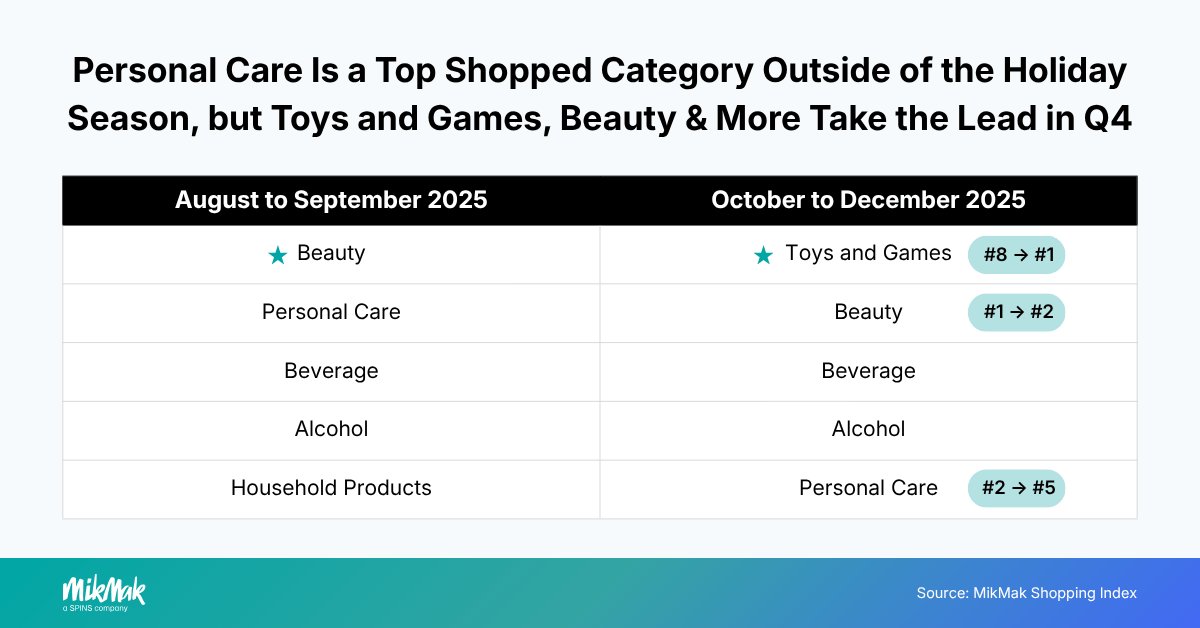
The 2025 holiday season illustrates how differently those patterns can play out. Toys and Games jumped from #8 to #1 in share of shopper clicks to retailers from Q3 to Q4 2025. In contrast, Beauty moved from #1 to #2, remaining near the top, while Personal Care shifted from #2 to #5 during the same period.
As you move through the trends that follow, use the MikMak Shopping Index benchmarks to understand the broader holiday landscape, then layer in your own shopper analytics across category, brand, product, and market performance to make more informed decisions for your Holiday 2026 plan.
Holiday Starts Earlier Than Most Brands Think
By August 2025, holiday purchase intent was already meaningfully in motion. August accounted for 18.8% of MikMak-tracked clicks from brand experiences to retailer sites between August and December, compared with 12.1% in 2024. Yet November still held the largest share at 25.2%.
Those numbers give marketers something more useful than another indication that holiday is starting earlier: a reason to question whether their own planning calendar reflects when shoppers actually begin showing intent.
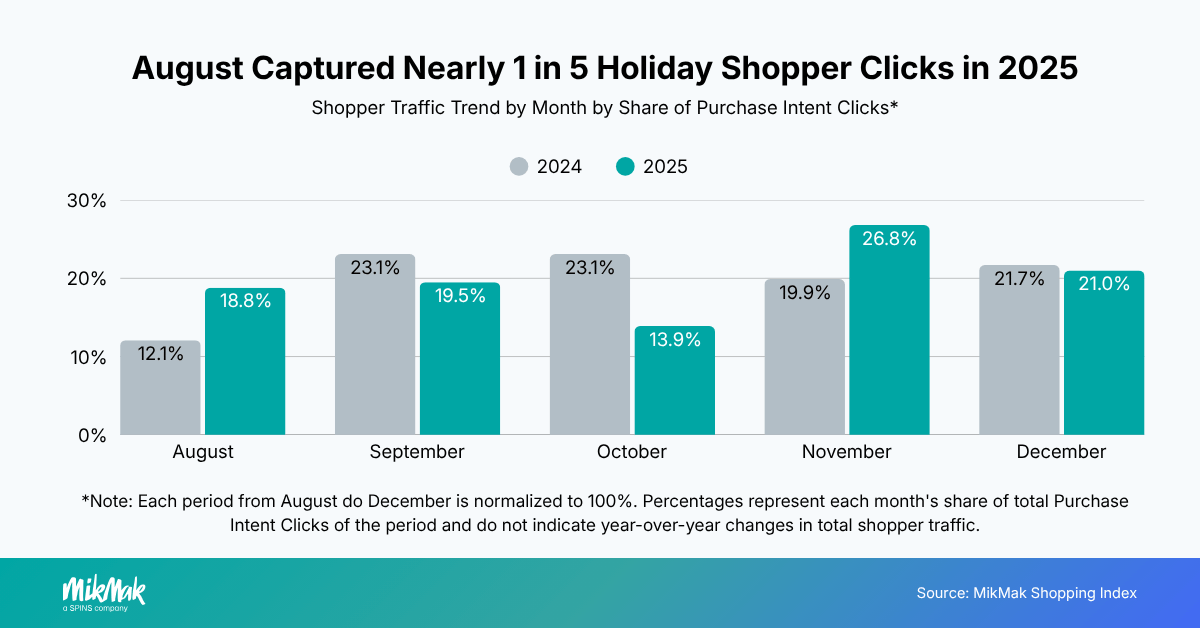
*Purchase Intent Clicks: Measures high-intent shopper traffic by counting the number of times a shopper clicks through to at least one retailer during a single session within MikMak Commerce-enabled brand content.
Nearly one-fifth of shopper clicks to retailers across the five-month period occurred in August 2025. That doesn't mean every brand should move its holiday calendar into August. It means the timing of your holiday plan should be validated against when purchase intent begins building for your category and brand, rather than copied over from last year's calendar.
By the time November arrives, some shoppers may already have spent weeks discovering products, considering their options, and deciding what's worth buying. The question for Holiday 2026 isn't simply whether to start earlier, but identifying when your brand needs to start influencing the decisions shoppers will make later.
There Is No Single Holiday Demand Curve
Holiday demand doesn't build the same way every year. Weekly shopper behavior from 2024 and 2025 shows two distinct patterns: 2024 built toward a pronounced mid-November spike, while 2025 saw stronger activity earlier in October followed by a more gradual build across the rest of the season.
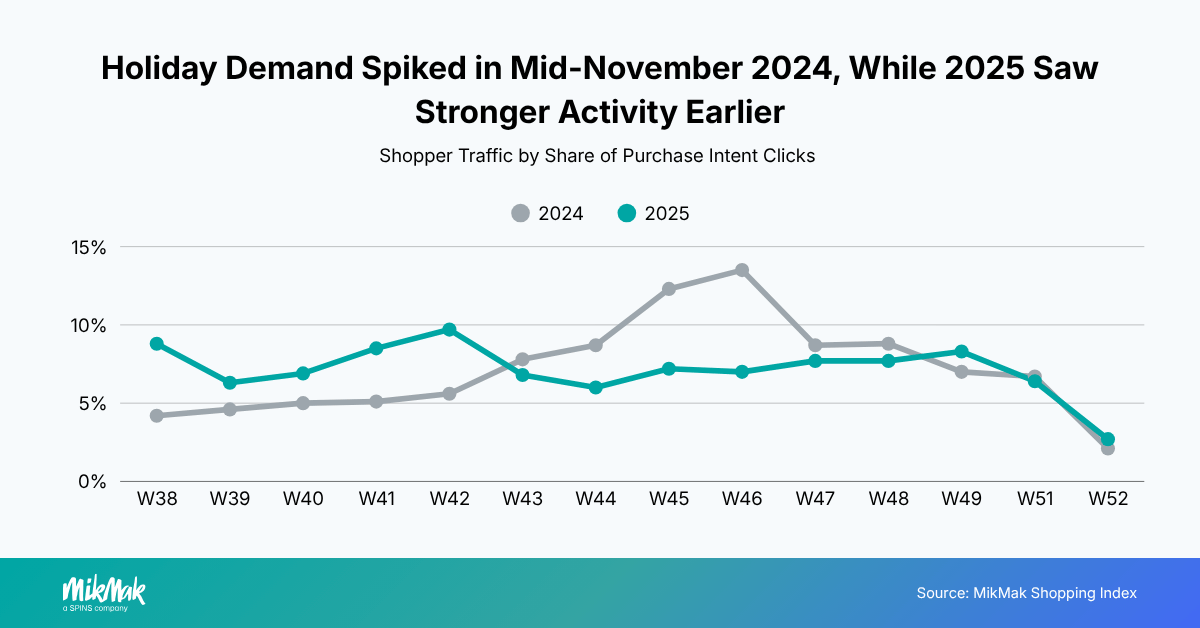
Black Friday remains a known anchor of the holiday season, but the demand pattern around it can vary significantly from one year to the next. Historical performance can help establish expectations, but current-season data reveals how demand is actually developing. The goal isn’t simply to recognize that the season is unfolding differently, but to understand what those changes could mean for the next phase of investment while there’s still time to act.
That doesn't mean a longer holiday window requires spending at peak levels for longer. It means your plan needs enough flexibility to respond to the shape demand actually takes.
Some of the Biggest Shopping Days Happen Before Black Friday
In 2025, Black Friday was the #1 shopping day of Q4, accounting for 3.2% of MikMak-tracked shopper clicks to retailers from October through December. Yet the activity leading up to it was just as important: seven of the other nine Top 10 shopping days occurred before Black Friday.
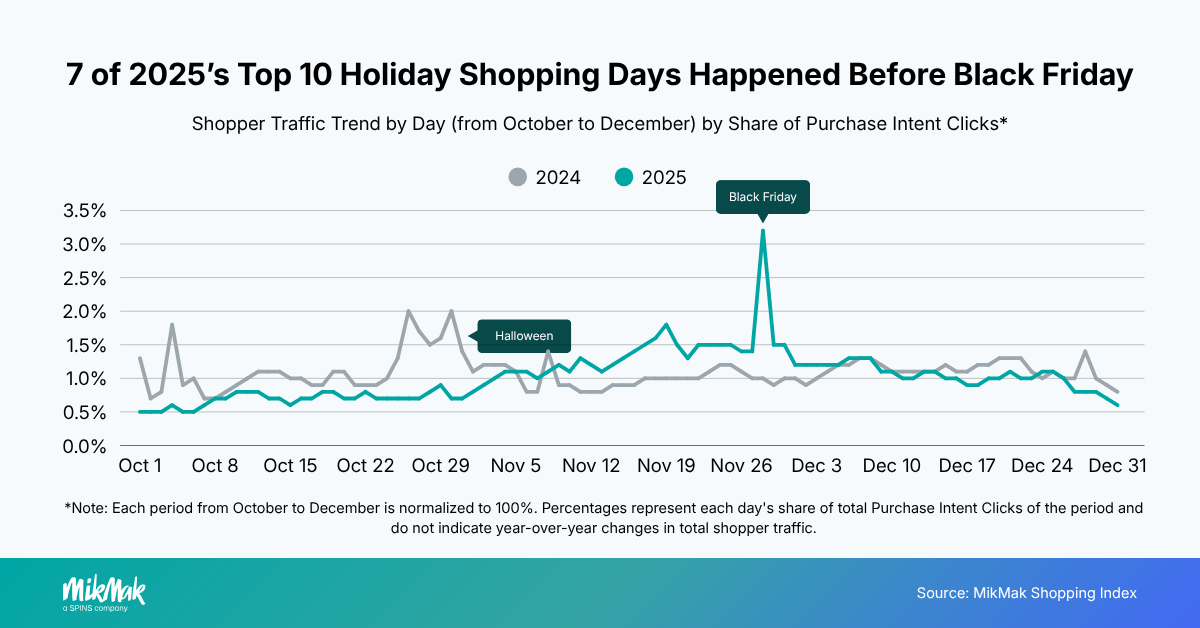
For marketers, those high-intent days shouldn’t be treated as simply a lead-up to the peak. They're meaningful shopping moments in their own right, and your holiday plan needs to be prepared to capture demand when it appears.
They're also an opportunity to learn. Throughout November, brands can see which products are gaining traction, which channels are driving high-intent traffic, and which retailers shoppers are choosing. That makes the lead-up to Black Friday a live read on many of the assumptions made during holiday planning.
The product you expected to be your hero may not be the one gaining the most traction. The channel you expected to drive high-intent traffic may be outperforming or underperforming expectations. Shoppers may be choosing different retailers than you anticipated.
The question then becomes: What does that tell you about where your next dollar should go?
IN PRACTICE:
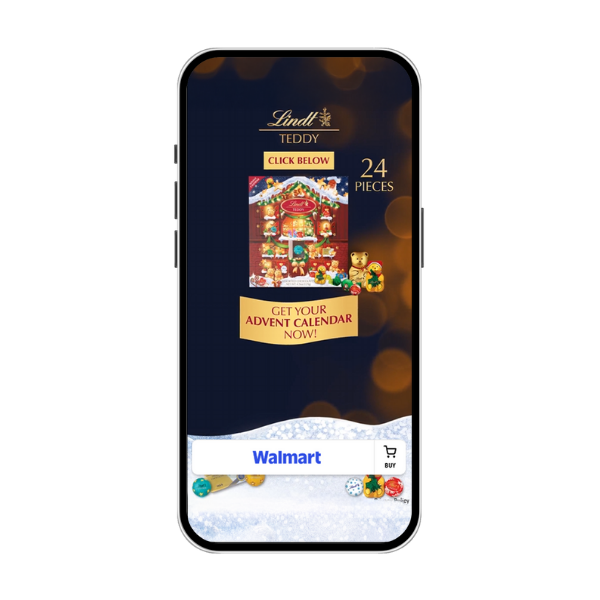
Lindt used in-season performance data to optimize its holiday Advent Calendar campaign while it was still running.
By adjusting its creative and retailer mix based on shopper behavior, the campaign drove a 40x higher Purchase Intent Rate and $182K in attributable sales.
Last Year's Channel Mix Is Only A Starting Point
Where shoppers show purchase intent can change significantly from one holiday season to the next.
In Q4 2024, Paid Social accounted for 82.7% of MikMak-tracked shopper clicks to retailers. By Q4 2025, that share had fallen to 47.5%. At the same time, Paid Search grew from 3.2% to 21.9%, while Organic Search increased from 5.0% to 18.5%.
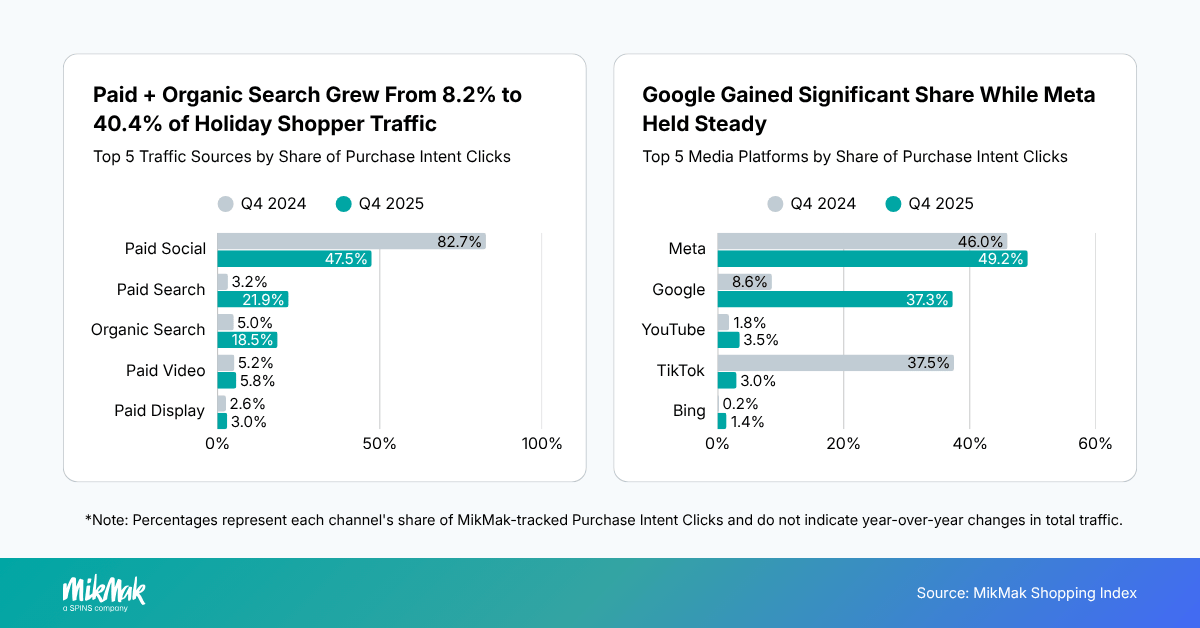
In 2025, Paid Social remained an important source of holiday purchase intent, but Search became significantly more influential. Both Paid and Organic Search accounted for a much larger share of MikMak-tracked shopper clicks to retailers in 2025, reinforcing the need for a more diversified holiday media strategy.
A shift this significant doesn't necessarily call for moving budget from social to search. Instead, it raises a more important question: how much should last year's channel performance dictate this year's plan?
A shopper might discover a product on social, search for it days later, and ultimately click through to a retailer from search. One channel may help create demand while another captures it. Looking only at where the high-intent action happened can miss part of what moved the shopper there.
And that journey is getting more complex. MikMak Shopping Index data shows AI referral traffic increased 48x from January 2025 through July 2026, adding another emerging source of product discovery for marketers to account for.
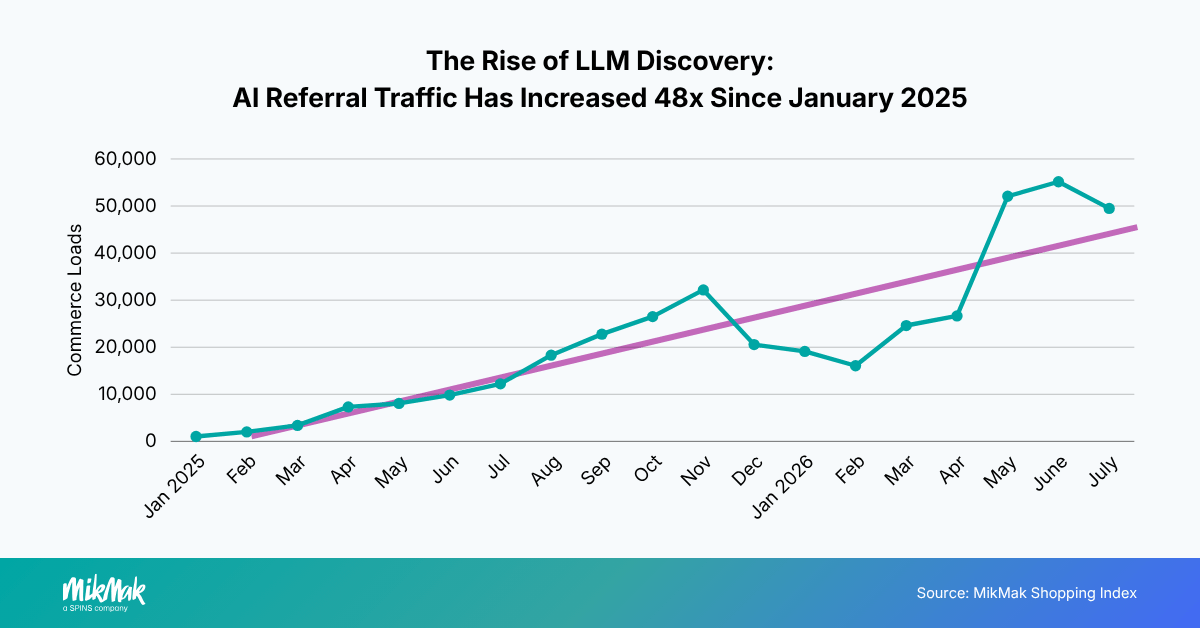
For Holiday 2026, a shopper looking for a gift might encounter a product through social, ask an AI assistant for recommendations, search reviews or availability, and eventually click through to a retailer. Understanding how those touchpoints work together matters more than simply identifying which one generated the final click.
IN PRACTICE:
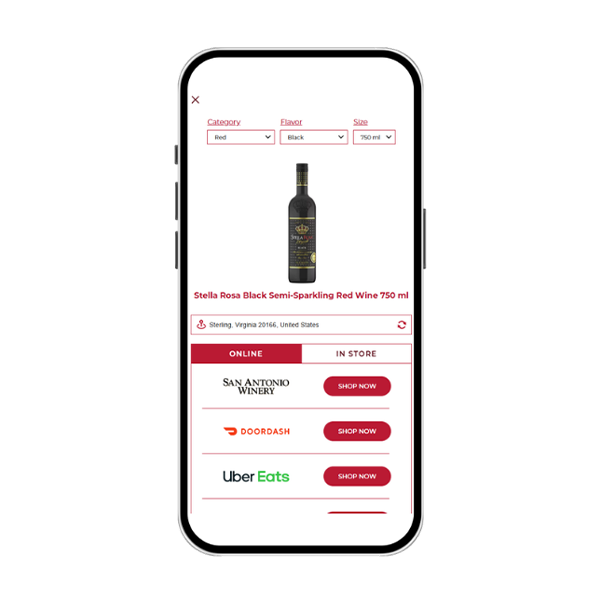
Riboli Family Wines made their Stella Rosa holiday media shoppable, creating a direct path to retailers while also helping the team understand how paid media influenced traffic and purchase intent on the brand website.
Media generated 80% of traffic as the primary demand driver, while the brand website accounted for 40% of total retailer click-throughs during the campaign, showing how paid and owned experiences can work together to drive and capture holiday demand.
Your Holiday 2026 Checklist
Holiday plans are built before marketers know exactly how the season will unfold. Instead of trying to predict every shift, focus on establishing what you expect to happen, identifying which signals could challenge those expectations, and being ready to act on what you learn.
Before the Season
✔ Pair historical insights with predictive modeling.
Use historical shopper behavior and cross-channel benchmarks to establish your baseline, then look forward with predictive modeling like MikMak Aura. Pressure-test how changes to flighting, channel mix, or retailer allocation could affect incremental sales before the season is fully underway.
✔ Make your products easier for AI shopping engines to discover.
Look beyond traditional search to understand how your brand is positioned for discovery through AI. Make sure product data is structured and accurate, retailer availability is easy to understand, and the content and signals surrounding your brand give generative engines the information they need to surface your products in relevant shopping moments.
✔ Document your biggest assumptions.
Write down what you expect to happen: which products will lead, where demand will originate, which retailers shoppers will choose, and how you expect channels to work together. Making those assumptions explicit gives you something meaningful to measure against once the season begins.
✔ Decide what can change, and what would warrant it.
Identify which parts of your plan have room to move, then agree on the signals that would justify increasing investment, shifting messaging, changing product or retailer priorities, or reallocating media. That gives teams a framework for acting on meaningful changes without reacting to every fluctuation.
During the Season
✔ Check your assumptions throughout the season.
Compare what shoppers are actually doing with what you expected across products, channels, retailers, and purchase intent. Pay particular attention when behavior begins to diverge from the patterns or expectations you planned around.
✔ Investigate the signal before acting on it.
When something differs from the plan, ask why. If search is capturing more purchase intent than expected, for example, look at what may be creating that demand before automatically shifting more investment there.
✔ Turn what you're learning into the next decision.
Focus on the decisions you can still influence. Use current-season signals to inform the next phase of media, creative, product, and retailer investment while there's still time to affect the outcome.
Commerce intelligence can help teams connect those signals to media and sales outcomes, evaluate the potential impact of different investment decisions, and identify where changes could drive greater incremental revenue.
Turn Holiday Signals Into Action With MikMak
Understanding what happened last season is valuable, but it’s only the starting point. The brands that perform best in Holiday 2026 will be the ones that take it one step further: predicting where demand is heading and knowing where to direct media traffic across an increasingly fragmented landscape.
MikMak is the only platform that brings historical commerce intelligence together with predictive forecasting and real-time optimization to help brands understand what’s driving purchase today, anticipate what could happen next, and act on those signals while there’s still time to influence the outcome.
UNDERSTAND WHAT’S HAPPENING
MikMak Insights
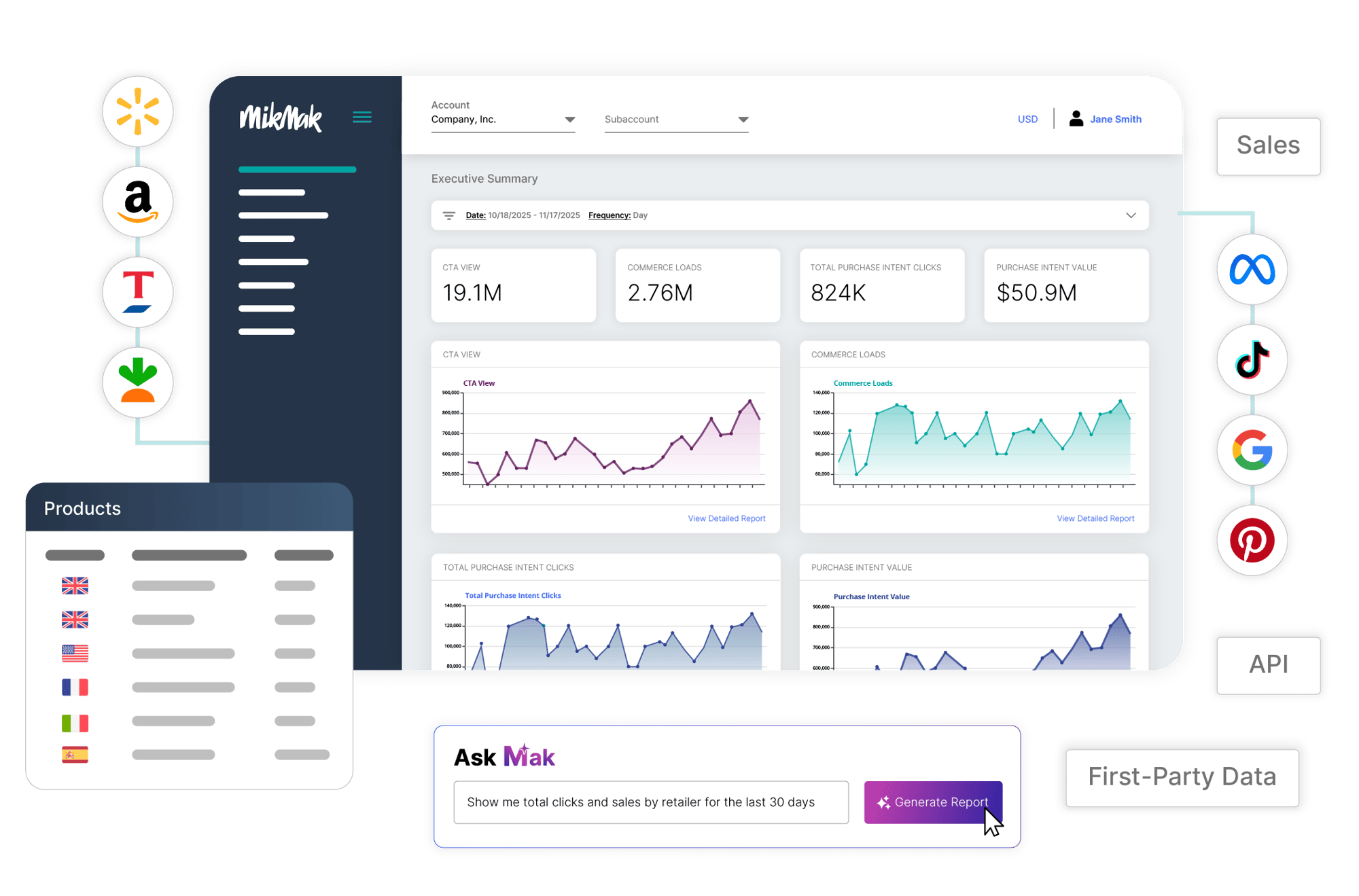
Connect media performance with shopper and sales signals to understand what's driving purchase across channels, products, retailers, and markets.
See where purchase intent is building, benchmark performance against your category, understand attributable sales and basket-level profitability at select retailers, and create custom views around the questions that matter most to your business.
Analyze with Mak makes that intelligence easier to act on by letting teams ask questions of their MikMak data in natural language and quickly surface performance drivers, trends, and opportunities.
INFORM WHAT HAPPENS NEXT
MikMak Aura
MikMak Aura takes that intelligence further by connecting commerce signals to media and sales outcomes.
Predictive forecasting and scenario planning help teams evaluate potential investment decisions and understand where changes could drive greater incremental revenue.
As the season unfolds, teams can incorporate current performance signals, revisit potential scenarios, and make more informed adjustments while there’s still time to influence incremental sales.